

What is legal marketing?
Legal marketing is the set of strategies used by lawyers and law firms to attract potential clients, establish their market position and convert opportunities into business. In Brazil, these activities must comply with the rules of the Brazilian Bar Association, the OAB, including OAB Provision No. 205/2021. Lawyers and law firms operating in other countries must observe the advertising, ethics and professional conduct rules applicable in their own jurisdictions. Legal marketing is not limited to social media or digital presence. It is a structured practice that involves:- brand positioning
- content production
- presence across strategic channels
- authority building
- demand generation
Legal marketing is not traditional advertising
There is an important distinction. Under Brazilian professional rules, aggressive or commercialised advertising is prohibited, while informative and strategic content is permitted, subject to the limits established by the OAB. Rules vary between countries. Each lawyer or law firm must evaluate the restrictions imposed by the competent bar association or regulatory authority in the jurisdiction where they practise. In practical terms, legal marketing is not about directly selling legal services. It is about educating the market, developing a clear position and becoming a trusted choice.How legal marketing works in practice
The process is simpler than it may seem, but it requires consistency.
1. Attraction: the firm becomes visible in the channels where potential clients seek information, including Google, social media, legal publications and news outlets.
2. Authority building: over time, the firm becomes recognised as a reference in a particular field. This is achieved through relevant content, consistency and clarity.
3. Conversion: the potential client recognises the value of the firm and makes contact. This process rarely happens after the first interaction. Clients observe, compare and then decide.

Discover our services or get in touch to start this conversation.
[metaslider id="1582"]Legal marketing channels and tools that can deliver results
Content production
Content is the engine of the strategy. It supports SEO, feeds social media channels and strengthens the firm's authority. However, producing content consistently is one of the greatest challenges lawyers face today. They lack time, clarity about which subjects to address and, in many cases, strategic direction. When properly structured, ghostwriting directly affects how a lawyer is perceived. See how our content service for lawyers works.Social media
Social media is not about going viral. It is about consistency and positioning. LinkedIn is particularly relevant for B2B relationships. Instagram can also contribute to visibility and the perception of authority. Our methodology is based on the understanding that social media has become one of the main reputation assets in the legal market. It must therefore be managed with intelligence, consistency and purpose. Content production is supported by careful visual design that can improve performance. We create visual materials designed to optimise reading and engagement, adapting the content to different formats and platforms without compromising consistency or technical depth. Learn more about our social media service for lawyers.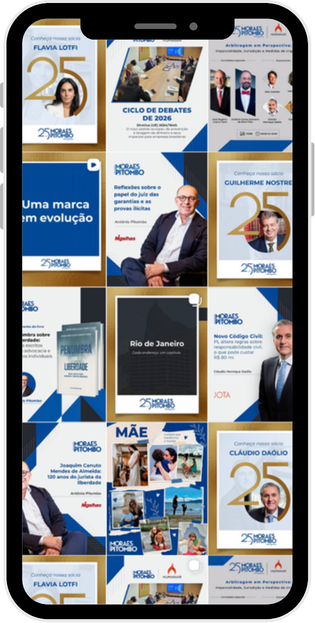
Media relations
Media coverage generates credibility. It is one of the fastest ways to strengthen a law firm's reputation. Securing this coverage requires more than identifying which publications and news outlets are most strategic for the firm. It also requires direct relationships with editors and journalists. This is precisely the role of a media relations team. Arabia Comunicação is a leader in media relations for law firms within the Brazilian legal marketing sector. We have the highest volume of television coverage. In 2025 alone, we secured more than 700 media placements, approximately 14.3% of which were on television. This type of exposure strengthens the perception of credibility and positions the firm differently in the eyes of clients and the wider market. Learn more about media relations for lawyers.Legal branding
Many law firms begin with a brand that is weak or misaligned with the audience they want to reach. Legal branding defines how the firm is perceived in the market. This includes the firm's name, visual identity, positioning and language. A well-designed brand facilitates every other strategy because it builds trust and differentiates the firm. This process requires a detailed analysis of the firm's internal and external environment. The objective is to identify genuine positioning opportunities and build a solid, coherent brand capable of supporting future growth. Discover our work in branding for lawyers and law firms. [metaslider id="1548"]Legal rankings
Being recognised by legal rankings is not merely a matter of prestige. For many firms, particularly those advising large companies, rankings can influence procurement processes, panel appointments and competitive tenders. Achieving recognition in legal directories requires strategy, well-organised information and an effective narrative. It is one of the most underestimated, yet strategically important, channels available to law firms. A strong legal rankings strategy begins with a detailed review of the firm's history across the directories. This includes its current rankings, progression over time, direct competitors and potential for growth in each practice area. Based on this assessment, the firm can define its priorities by deciding where to compete, how to compete and which differentiators should be emphasised.See also our article on how law firms can get started with legal rankings
Strategic consulting for law firms
In some cases, the challenge is not limited to communication. It also involves the firm's business model. Strategic consulting can support the firm's growth by focusing on:- identifying expansion opportunities
- developing new markets
- creating cross-selling strategies
- organising practice areas and services
Website
A website is not necessarily the client's first point of contact with a law firm. However, it is often where that client validates a decision. After reading an article, receiving a referral or finding the firm on Google, the next step is frequently the same: visiting its website. The website should not be treated merely as an institutional showcase. It should be regarded as a strategic asset capable of communicating the firm's value proposition, organising its narrative and supporting its digital presence in the legal market. A website project involves creating institutional and technical content using language appropriate for the legal sector, developing an elegant and functional interface, and ensuring technical performance in terms of speed, accessibility and stability. See how we develop websites for lawyers and law firms.Legal marketing strategies that can deliver results

Define a position based on the market, not only on a practice area
Choosing a practice area is not enough. What truly differentiates a law firm is how it positions itself within the market. Two firms may both practise employment law and achieve completely different results depending on:- the audience they serve
- their target client profile
- their value proposition
- the language they use
Connect marketing with business objectives
One of the most common mistakes is treating marketing as an isolated function. Effective marketing is built on the firm's strategic decisions, including:- which practice areas it wants to grow
- which clients it wants to attract
- which services offer the greatest potential
Not sure how to choose a legal marketing agency? Read this article.
Produce content with purpose and depth
Content is not about volume alone. It requires direction. Every piece of content should fulfil a role within the strategy:- attracting people who are not yet familiar with the firm
- educating those who are evaluating their options
- providing confidence to those who are close to making a decision
Build a continuous and coherent presence
Presence is not simply a matter of posting frequently. It requires consistency and coherence. The firm should present an aligned message across every point of contact, including social media, Google, the media, its website and legal rankings. When the message is consistent, perceived value increases. When the different channels are disconnected, they create confusion.Use multiple channels in an integrated way
No single channel can sustain predictable growth on its own. Results come from combining:- content that supports visibility on Google
- a presence reinforced through social media
- authority built through media coverage
- validation through the website and legal rankings
Think about growth beyond communication
In many cases, the main barrier to growth is not a lack of visibility. It is the firm's internal structure. More advanced strategies may involve:- identifying cross-selling opportunities
- expanding into new markets
- organising strategic practice areas
- developing new services